
Try ranking your ten favourite films in one go, and you will probably produce an order you immediately want to change. The top and bottom come easily. The middle ends up in whatever order you happened to read it.
Choosing between two is a different story. “Which do you prefer, this or that?” is a question most people answer quickly and consistently. Ask it enough times, in a sensible order, and a full ranking falls out. This is called pairwise comparison, and it is the easiest way to rank a long list honestly.
How many choices does it take?
If you compared every item against every other, a list of n items needs n(n-1)/2 comparisons. That is 45 for 10 items, 190 for 20 and 435 for 30. Nobody finishes that with their attention intact.
You do not need all of them. If you say A beats B and B beats C, nobody needs to ask about A and C: the answer follows. A sorting method such as merge sort uses that, and needs roughly n times log n questions instead.
- 10 items: about 21 to 25 questions, against 45.
- 16 items: up to 49, against 120.
- 20 items: around 60, against 190.
- 30 items: around 110, against 435.
The exact count depends on your answers, so any “question 13 of about 49” counter is an estimate.
Four ways to keep it honest
Decide what “better” means first. “Which movie is best” and “which would I rewatch tonight” give different orders. Pick one question and keep it in mind for every pair. Switching halfway makes the result meaningless.
Trim before you start. Every item you cut saves several questions. Remove duplicates and anything you already know does not belong.
Name items so they can be compared. Short, concrete labels make each choice faster.
Undo a misclick right away. One careless tap can place an item a few places from where it belongs. Look for an undo, and use it at once.
A note on consistency: people are not perfectly transitive. You can prefer A to B, B to C and still C to A. A sorting method will never ask you that third question, so the cycle cannot appear in your answers, but it is a reason to treat the exact order of close neighbours as soft. For genuine toss-ups, an “equal” option is better than a coin flip.
Doing it in My Ranking
My Ranking is an iPhone app that does exactly this. You build a list (a custom one, or one of more than 30 presets for movies, food, sports and more), pick an algorithm, and answer one question at a time: which of these two is better.
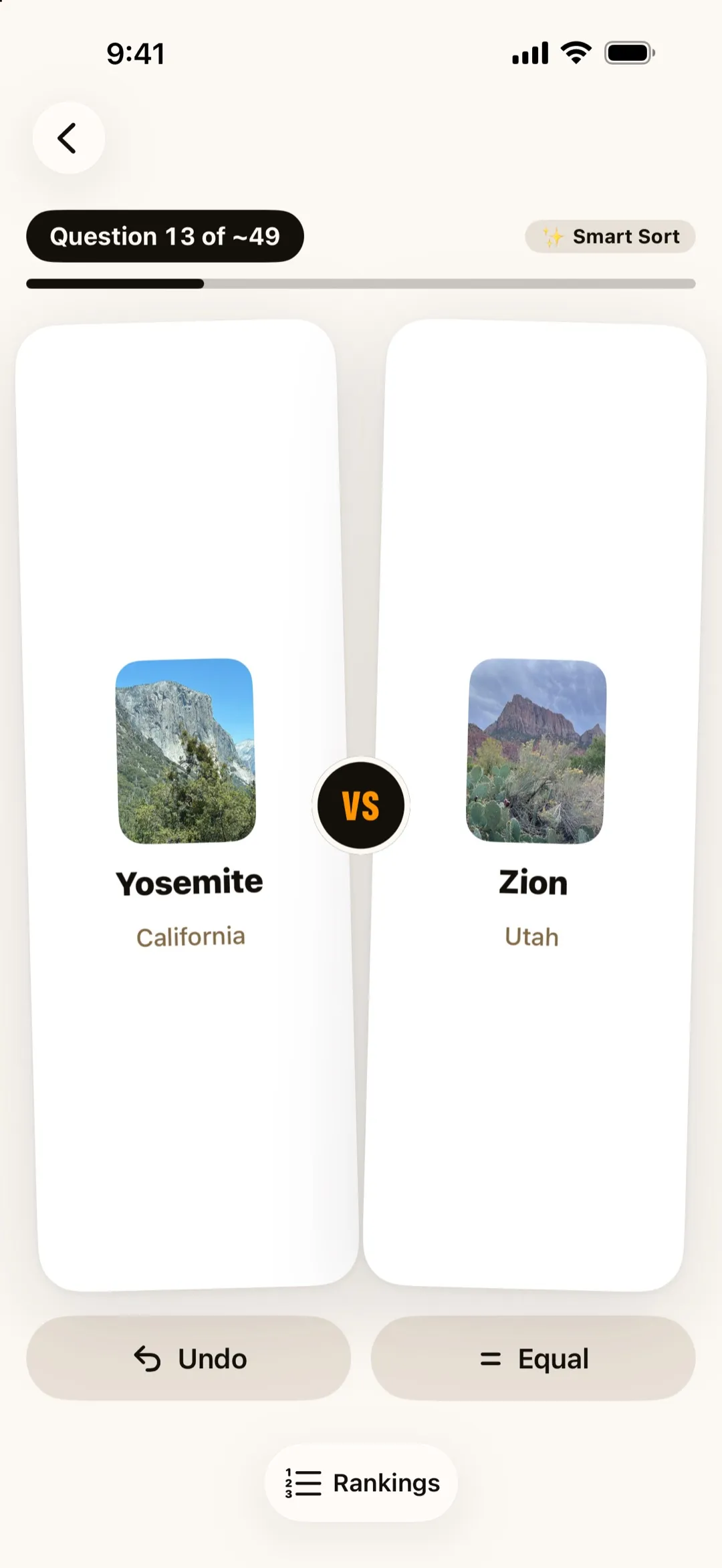
The default, Smart Sort, splits your list, sorts each half and merges the results, comparing a pair only when it is needed. That is the merge-sort approach above, and it is the one you can use on Free, with comparisons, full results and copy-as-text. You can undo recent answers, mark a pair as equal, and open a live ranking while you go.
When you finish, you get a ranked list with how many questions you answered, how many you skipped and how long it took, and a card you can share.
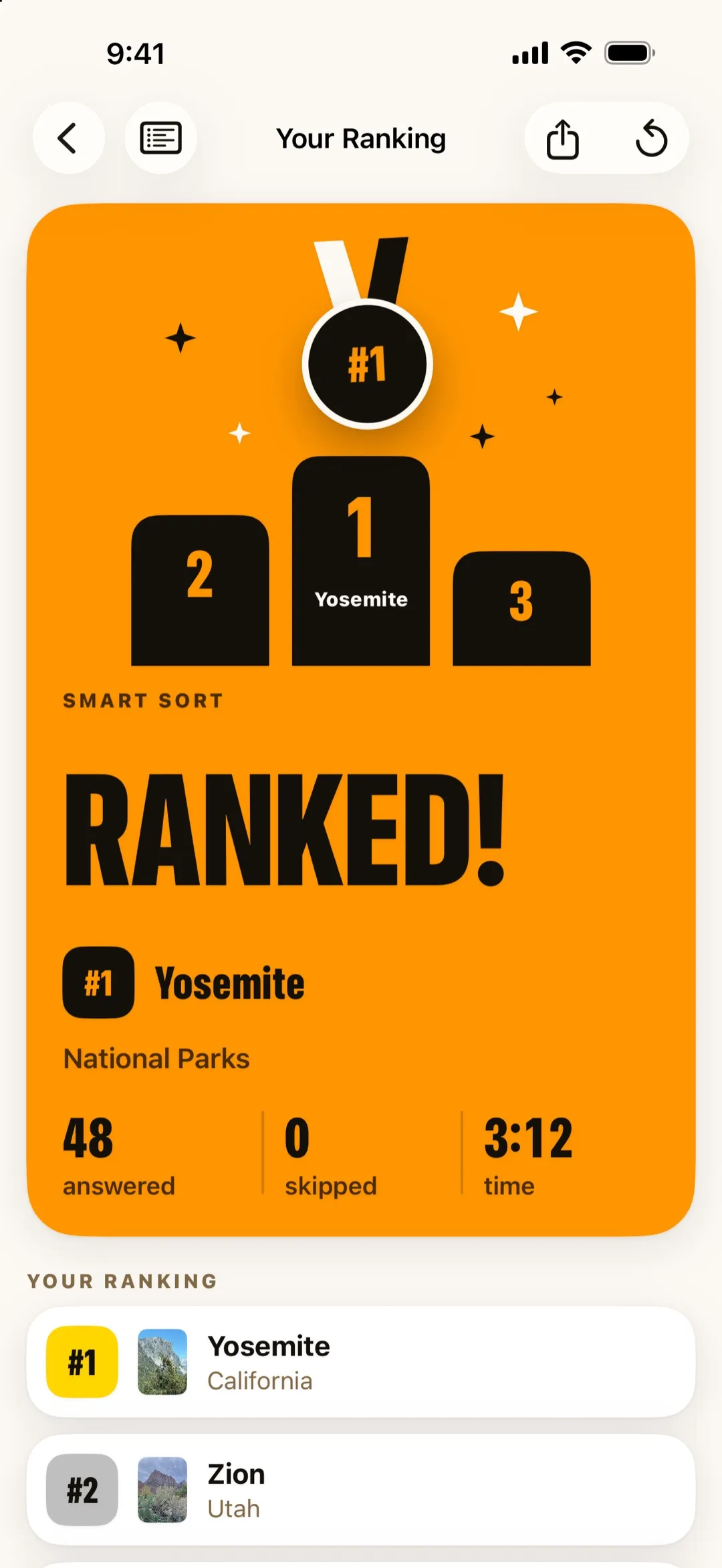
Free lets you try this on a real list before any purchase, with limits on lists, items per list and new rankings per week that differ from Pro, so check the store page for the current numbers. Photos on items are Pro, and so are the other algorithms, which we compare in Elo, Swiss or knockout.
The app works offline, with no account, no ads and no tracking. Your lists stay on your device.
Try it with a list you care about
- Write down 8 to 12 things you want in order: films, restaurants, holiday spots.
- Decide the one criterion.
- Answer the pairs without overthinking. Go with the first answer.
- Read the result, and if the middle feels wrong, that is usually where your preferences are closest.
Ten choices, and you will know your real top three.


