
You have a long list and you want it in order. There are several ways to run the matchups, and they are not interchangeable: each one gives you something different, and costs a different amount of effort.
This is a plain guide to the four common methods, so you can pick one before you start answering.
The four methods, in one line each
- Sorting (merge or insertion). Compares only the pairs it cannot work out from your earlier answers, and ends with a complete order.
- Knockout (single elimination). Winners advance, losers are out, and you get a champion.
- Swiss tournament. Each round pairs items with similar records, and a ranking emerges after a few rounds.
- Elo rating. Every matchup nudges two scores up or down, and the order keeps improving the more you answer.
Knockout: fast, and good at one thing
A bracket needs n-1 matchups: 15 for 16 items, 31 for 32. It is by far the cheapest method, and it is very good at one thing, finding a winner.
It is weak below the top. Everyone who lost in round one is effectively tied, however different they are, and who you were paired with decides a lot. Use a knockout for “what is my number one” or when the fun is the bracket itself. Do not use it to order the whole list.
Sorting: the full order for the fewest questions
A sorting method asks the questions needed to place each item and no more, because “A beats B, B beats C” already settles A against C. For 16 items that is at most 49 questions, against 120 for comparing every pair.
You get a complete order. It leans on your answers being consistent, and a careless tap can misplace an item, so undo matters. This is the sensible default when you want everything ranked and have a patient evening.
Swiss: fair, and good for close lists
A Swiss system, as used in chess events, does not eliminate anyone. Each round, items with similar records meet, so strong items face strong items and the order sharpens each round. It takes a few rounds, and gives a complete order that treats every item the same way, rather than punishing one unlucky first pairing. An optional refinement round can sharpen close calls.
Use it when there are lots of close contenders, or when you want fairness more than speed.
Elo: for ongoing, noisy or huge lists
Elo is the rating system from chess. Each answer adjusts the ratings of the two items: beat a strong item and you gain more. There is no fixed number of questions. More answers make it more accurate.
That makes it the right tool for a very long list, or a list you will keep answering in spare moments, such as 50 desserts you will never finish in one session. It is approximate, and the order near the middle stays soft until you have given it many answers.
A quick chooser
| You want | Use |
|---|---|
| Just the winner | Knockout |
| A full order, fewest questions | Sorting |
| Fairness with close contenders | Swiss |
| A big list, a bit at a time | Elo |
Doing it in My Ranking
My Ranking offers all four. When you start a ranking, a Choose Algorithm screen shows each method with what it is best for, a rough question-count formula, and how many answers you can undo.
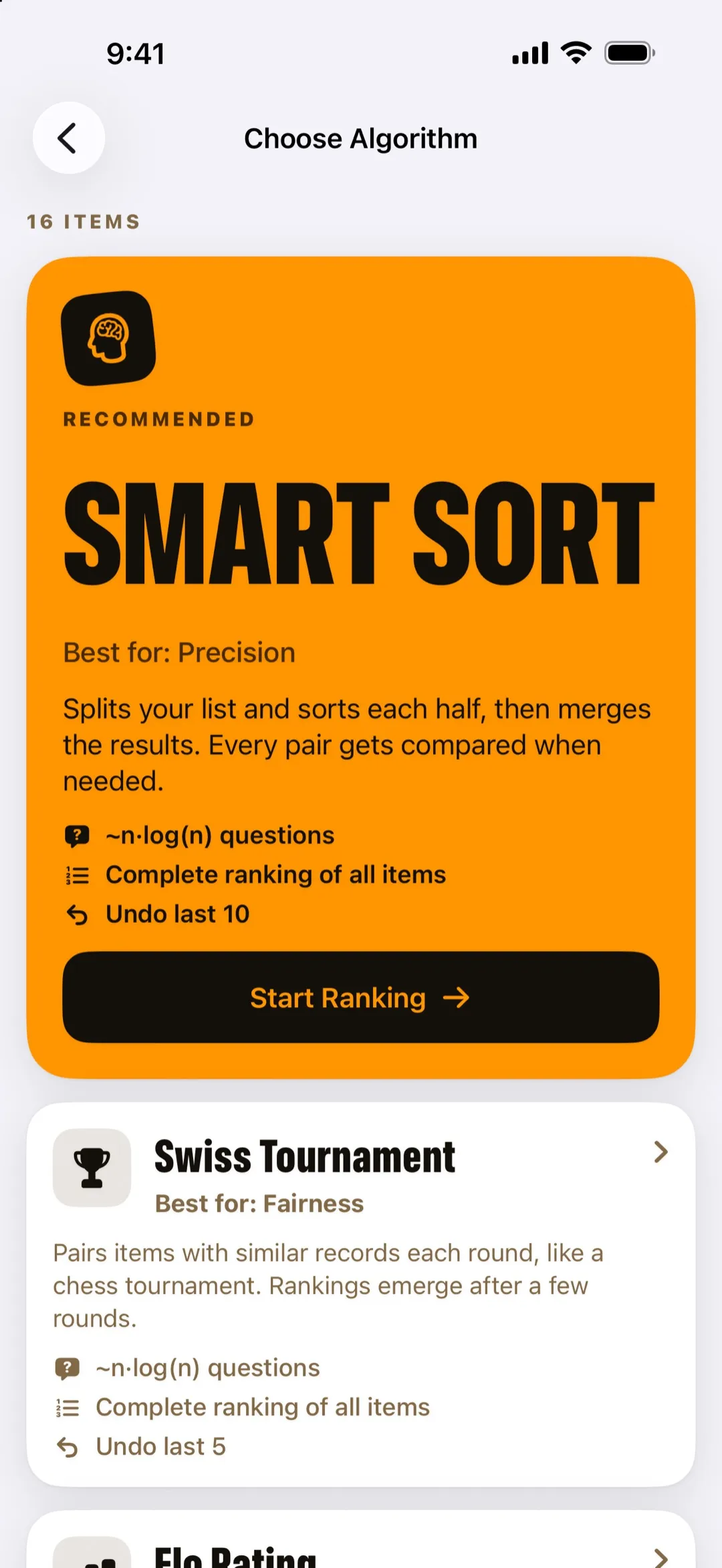
Smart Sort is the sorting method, and it is the one available on Free. Elo, Swiss (with its optional refinement round) and Elimination are part of Pro, a monthly, annual or lifetime purchase. The app describes Elimination as fast but top-heavy, which is the trade-off above in two words.
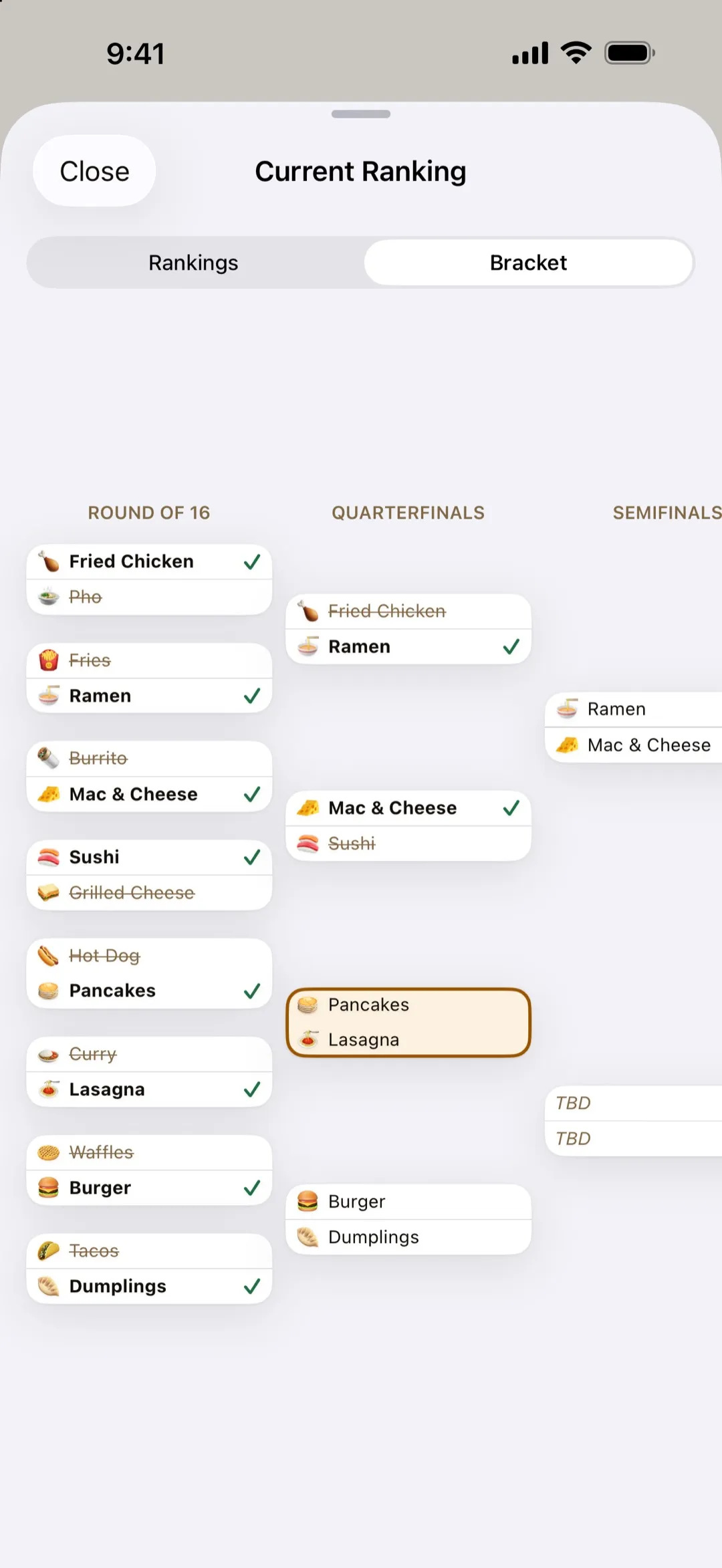
In Swiss and Elimination you can open a live bracket while you rank to see matchups as they play out.
My Ranking works offline, with no account, no ads and no tracking, and your lists stay on your device.
Which should you start with?
If you are not sure, sort. It is the best balance of effort and result, and it is the method behind our guide to ranking a list by comparing two items at a time. Reach for a knockout when you only care about number one, Swiss when the contenders are close, and Elo when the list is too long to do in one sitting.


